Foundation Repair Cost
How Much Does Foundation Repair Cost in Atlanta?
Foundation repair in Atlanta ranges from a smaller, contained crack repair to a larger structural job like bracing a bowing wall — and the gap between those is wide, because they're genuinely different work. What you'll pay depends on what's actually wrong, and our red clay soil is a big part of why foundations move here in the first place. Below is what drives the number, and when a crack is worth worrying about at all.
The honest version
What does foundation repair cost in Atlanta?
There's no single number for foundation repair, and any company that gives you one over the phone is guessing. A contained crack repair is a fraction of the cost of bracing a wall that's started to bow. Here's the honest range by the kind of problem you're actually dealing with:
| Problem | What it usually involves | Typical range |
|---|---|---|
| Foundation crack repair | Polyurethane or epoxy injection that seals the crack full-depth | Around $750 per crack |
| Bowing or cracking foundation wall | Carbon-fiber straps anchored top and bottom to stop the movement | $1,200–$1,500 per strap |
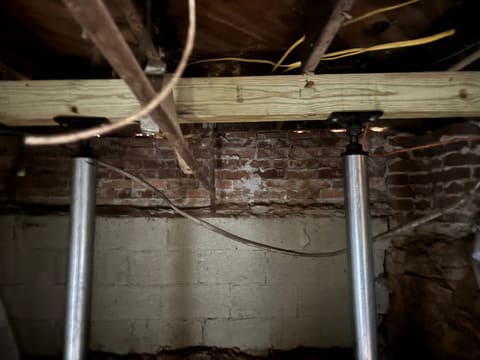
| Sagging or uneven floors | Drop girders and adjustable steel columns to carry the load and re-level the floor (we rebuild rotted joists or subfloor where water's damaged them) | About $185 per linear foot — most jobs run $2,000–$4,000 |
We don't run a calculator on this page on purpose — a number a website spits out before anyone has seen your foundation isn't a quote. The free inspection is where you get a real figure: we go under, find the cause, and put the scope and the price in writing before you commit to anything. If it's a bigger project, we offer interest-free financing so you can spread it out.
What affects the cost of foundation repair?
Two houses with the same symptom can land at very different numbers. Here's what actually moves it:
| Factor | Why it moves the price |
|---|---|
| Type of problem | A crack injection is a fraction of the cost of bracing a bowing wall or reinforcing failing structural support. |
| Extent of the repair | More cracks to seal, or more wall to brace and stabilize, means more labor and material. |
| Foundation type | Slab, crawl space, and basement foundations each repair differently. |
| Accessibility | Tight access, landscaping, and interior versus exterior work all change the labor. |
| How long it's gone unaddressed | Early cracks are cheap to handle. Years of movement compound the repair. |
| Whether an engineer is needed | Some jobs need a structural engineer's report first — we'll tell you when, even though it means hiring someone else before us. |
| Drainage corrections | If water is driving the movement, fixing the drainage is part of a repair that actually lasts. |
Why foundations cost what they do in Atlanta
Red clay is the through-line. It's expansive soil — it swells when it rains and shrinks in a drought, and that constant movement is the leading driver of foundation settlement across metro Atlanta. Through our long humid stretch it stays saturated and pushes on your footings; in a dry spell it pulls back and leaves them with less to bear on. That seasonal swing, year after year, is what works a foundation loose.
Pair that with pre-1980 homes in neighborhoods like Decatur, Druid Hills, and East Atlanta that were built before modern drainage standards, and you have the local reason national cost articles can't account for. The soil is why the work — and the number — is what it is here.
When you need a structural engineer (and when you don't)
Not every crack is an emergency, and not every foundation company will tell you that. A hairline crack in a poured wall is often just the concrete curing. Stair-step cracks in block, doors that won't latch, and floors pulling away from walls are the ones worth taking seriously.
When a job genuinely needs an engineer's report before anyone touches it, we'll say so — even though it means you're hiring someone else first. We'd rather you trust the diagnosis than rush the repair. That honesty is also why our scope, and our price, tend to be smaller than the always-the-biggest-fix outfits: we only repair what's actually moving.
How It Works
Four steps. No confusing jargon.
We keep the process simple and transparent so you know exactly what to expect before anyone starts work.
-
Inspection
We evaluate the crawlspace or basement and document what we find with photos and moisture readings.
-
Assessment
We review moisture levels, drainage, and structural integrity to understand the full picture.
-
Clear Plan
You receive a practical proposal tailored to your property. No jargon, no pressure, no surprises.
-
Repair
Our team performs the work and walks you through the result so you see exactly what was done and why.
Homeowner Proof
What Atlanta homeowners say.
Extremely happy and grateful for the service I received. They came out the same day I called for an estimate and provided it right away. I loved the entire experience, and would definitely recommend them and use them again.
Frequently Asked
Common questions
How much does foundation repair cost in Atlanta?
Is a foundation crack always serious?
Why do so many Atlanta homes have foundation problems?
Will my homeowners insurance cover foundation repair?
Do I need a structural engineer before repairs?
Does foundation repair cost more than crawl space work?
Don’t Wait Until It’s Major
Get a clear plan for the space below your home.
Schedule a crawlspace or basement evaluation and understand what needs attention — no pressure, no obligation.
Free & No Obligation
Schedule Your Inspection
Tell us what’s happening under the house. We’ll follow up within one business day.